
How Energy Markets Scale
What LNG bunkering, FLNG and FSRUs reveal about building commercially viable energy markets
At Asia LNG Week, LNG bunkering, floating LNG production and floating regasification were discussed under one roof for the first time. The physical connection is clear. FLNG brings gas into production. FSRUs provide access to importing markets. LNG bunker vessels deliver fuel to ships.
The more important connection, however, is commercial. Across all three discussions, the central questions were not primarily technical. They were:
Can supply be secured reliably and on competitive terms?
Can the infrastructure achieve sufficient utilisation?
Will customers make commitments that support investment?
Can risk be allocated appropriately between producers, infrastructure owners, traders and buyers?
The sessions may have focused on FLNG projects, FSRU development and the growth of LNG bunkering. The underlying issue was the same: What conditions are required for an energy market to scale?
Commercial viability depends on market alignment
Bio-LNG illustrates the challenge. The key technical pathways are established. Biomethane can be produced from a range of feedstocks, certified under recognised schemes, liquefied and supplied into the maritime value chain.
The more difficult questions concern commercial structure. Renewable fuel producers may require long-term offtake commitments (10-15 years) to finance new production capacity. However, shipping customers are often reluctant to commit to fixed volumes, routes or premiums over the same period.
This creates a structural mismatch between the financing requirements of supply projects and the procurement preferences of end users.
The same issue appears elsewhere in the LNG value chain.
An FSRU may provide a faster and more flexible route to gas imports than an onshore terminal. It still requires creditworthy counterparties, access to downstream infrastructure and a credible long-term utilisation case.
An FLNG project may commercialise offshore or stranded gas resources. Its viability still depends on resource quality, project cost, shipping arrangements, market access and sufficient certainty of sales.
An LNG bunker vessel too, without adequate demand visibility, its utilisation and returns remain uncertain.
These are not technical shortcomings. They are commercial and market-development constraints.
Five conditions determine whether a market can scale
Over the past few weeks, I have found myself assessing energy projects against the same five questions.
Together, they form what I think of as the SCALE Test.
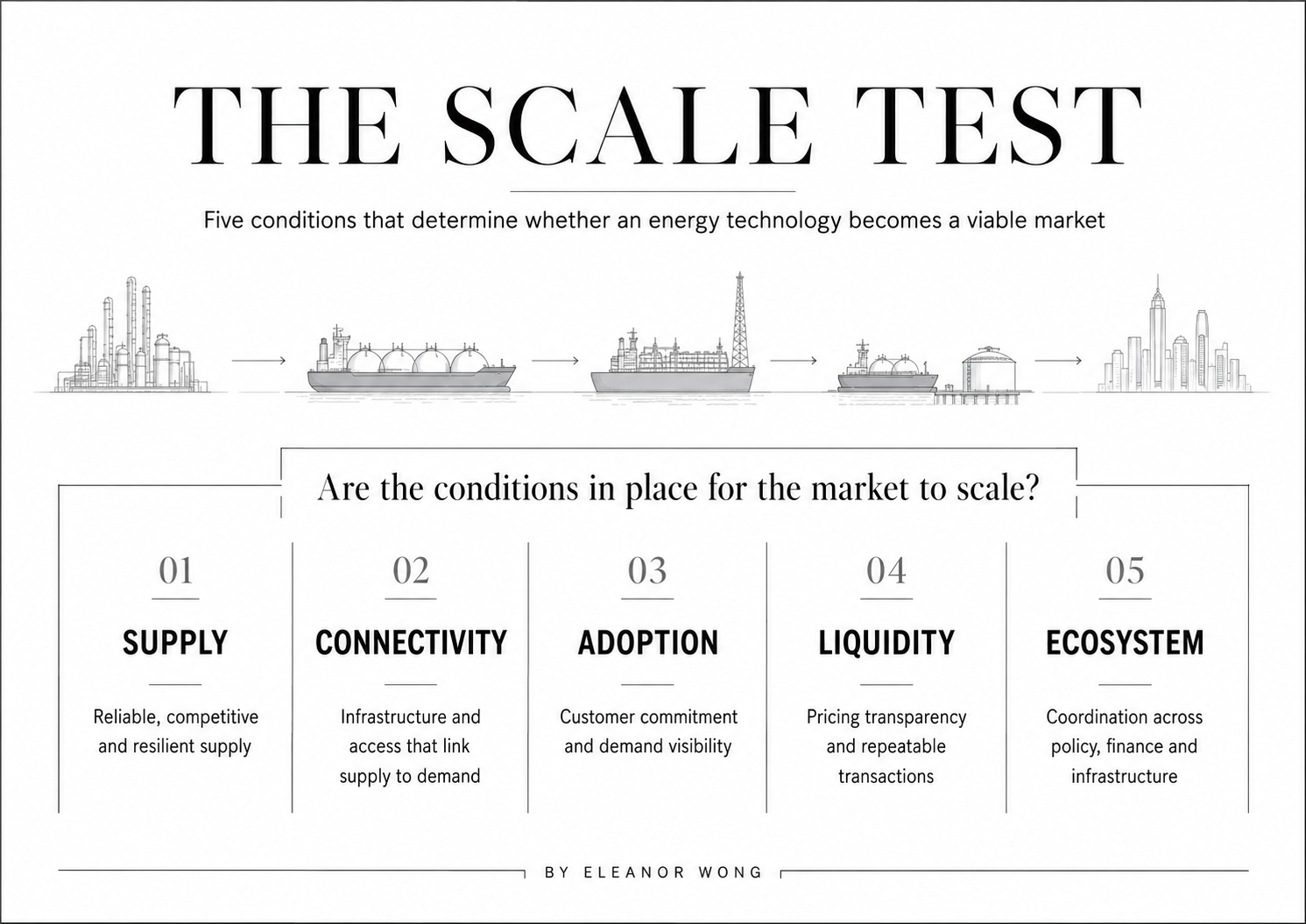
S - Supply
Can the market access supply that is reliable, competitive and resilient?
Supply is no longer just a question of whether the product is available. COVID-19, the war in Ukraine and disruption across major shipping routes have changed how energy security is valued. Buyers increasingly assess where supply originates, how exposed it is to disruption, whether alternative sources are available and how the supplier would respond to a failure in the primary supply chain.
Reliability has become a commercial differentiator. This is particularly relevant to the Asian LNG market. A supplier may have access to LNG, but customers will still assess its ability to deliver consistently across ports, seasons and market cycles. A diversified portfolio provides resilience.
C - Connectivity
Can supply reach the customer at the required location and time?
Markets require infrastructure and operating access across the value chain. Pipelines connect gas resources to liquefaction plants… LNG carriers connect production regions to importing markets… FSRUs connect global LNG supply with domestic gas systems… Reload terminals and LNG bunker vessels connect large-scale LNG infrastructure with marine customers.
This is why FLNG, FSRUs and LNG bunkering should not be viewed as unrelated sectors. They are different components of the same supply and delivery chain.
And connectivity extends beyond physical infrastructure. A terminal may exist, but are reload slots available? A bunker vessel may be available, but does it have the necessary licences and port approvals? A supplier may have access to LNG, but does it control sufficient storage, loading rights and operating capacity?
Infrastructure creates value only when it can be accessed and used commercially.
A - Adoption
Will customers adopt the product and make commitments?
Forecast demand is not the same as contracted demand.
This distinction is often understated in emerging energy markets.
Developers look at vessel orderbooks, policy targets and projected demand growth. Customers point to uncertain trade routes, evolving regulation and the continued availability of alternative fuels. Both may believe that the market will grow, but that does not mean either party is prepared to assume the initial investment risk.
For LNG bunkering, shipowners may order LNG dual-fuel vessels while retaining flexibility over fuel choice, bunkering location and supplier. That flexibility is commercially rational. It also limits the demand certainty available to suppliers and infrastructure investors.
A market becomes more investable when general interest is translated into specific commercial parameters:
A defined volume.
A delivery location.
A pricing mechanism.
A contract duration.
And, a clear allocation of volume, price and performance risk.
L - Liquidity
Can participants transact efficiently and repeatedly?
Early-stage markets are usually characterised by bilateral negotiation. Each transaction may involve a different price formula, product specification, delivery arrangement and allocation of risk.
More mature energy markets tend to develop common reference points: accepted specifications, transparent price benchmarks, more standardised contracts and established mechanisms for managing price and volume exposure.
Oil bunkering benefits from mature port benchmarks, established trading practices and a broad supplier base. LNG bunkering on the other hand remains more bespoke. Prices may be linked to gas indices, oil products, terminal fees, logistics costs or individually negotiated formulas.
This is not unusual for a developing market, but customers find it harder to compare alternatives. Suppliers find it harder to manage exposure. Investors find it harder to assess potential returns.
Pricing transparency and repeatable commercial structures are therefore important components of market development.
E - Ecosystem
Do policy, finance, infrastructure and demand support one another?
No participant can develop an energy market independently. Customers wait for competitive supply. Suppliers wait for stronger demand commitments. Infrastructure developers wait for greater utilisation certainty. Investors wait for bankable contracts. Governments wait for evidence that the market can become commercially sustainable.
Each position may be reasonable in isolation. Collectively, they delay investment. This is why collaboration alone is insufficient. The industry already collaborates through memoranda of understanding, feasibility studies, working groups and pilot projects.
What is required is greater coordination between policy, infrastructure development, commercial contracting and customer adoption. For example, an LNG supplier without vessel availability does not establish supply capability. A bunker vessel without terminal access does not establish a workable delivery chain. Customer interest without defined volumes does not provide a basis for investment. A renewable fuel mandate without an accepted certification framework does not create a product that can be transacted with confidence. The market develops when these components progress in a sufficiently coordinated manner.
The SCALE Test is a diagnostic tool
Not every market needs to be mature across all five dimensions before investment begins. The critical point is to identify the principal constraint accurately. The appropriate response depends on the constraint:
If supply is uncertain, the project may require a more diversified sourcing strategy.
If connectivity is limited, it may require additional infrastructure, access rights or operating capability.
If customer adoption is unproven, it may require an anchor customer, staged investment or lower initial capacity.
If liquidity is limited, it may require stronger contractual protection and a robust pricing methodology.
If the ecosystem is fragmented, it may require structured coordination between government, investors, suppliers and customers.
The purpose of the SCALE Test is not to disqualify immature markets. It is to identify where the commercial constraint lies, how it can be addressed and which party is expected to assume the risk.
A different way to view the LNG value chain
Bringing LNG bunkering, FLNG and FSRUs together was more than a conference-format decision.
It reflected how the LNG market is evolving. FLNG is not simply an upstream production solution. FSRUs are not simply floating import terminals. LNG bunkering is not simply a marine-fuel activity. Each provides a means of connecting LNG supply with new or expanding sources of demand. They can offer flexibility, accelerate market access and reduce the need for some forms of fixed infrastructure.
But flexibility does not eliminate commercial risk. It changes how that risk is distributed across the value chain. The next phase of the energy transition will not be determined only by technical performance.
It will also depend on whether industries can establish the supply chains, contracts, pricing mechanisms, infrastructure access and institutional arrangements required to support sustained investment and repeated transactions. The relevant question is therefore not only whether the technology works, but whether the conditions are in place for the market to scale.
Beyond LNG
The same questions apply across other energy-transition markets.
For green hydrogen, production cost receives considerable attention. Projects also require transport infrastructure, long-term demand, accepted certification and sufficient policy support.
For sustainable aviation fuel, mandates may support demand. Feedstock availability, production economics, customer willingness to pay and credible emissions accounting still determine whether projects proceed.
For carbon capture and storage, capture technology is only one part of the investment case. Transport infrastructure, storage capacity, liability allocation, carbon pricing and industrial participation must also align.
The technologies differ. The market-development requirements are similar. Where one condition is materially underdeveloped, a technically viable project may still fail to progress commercially.
