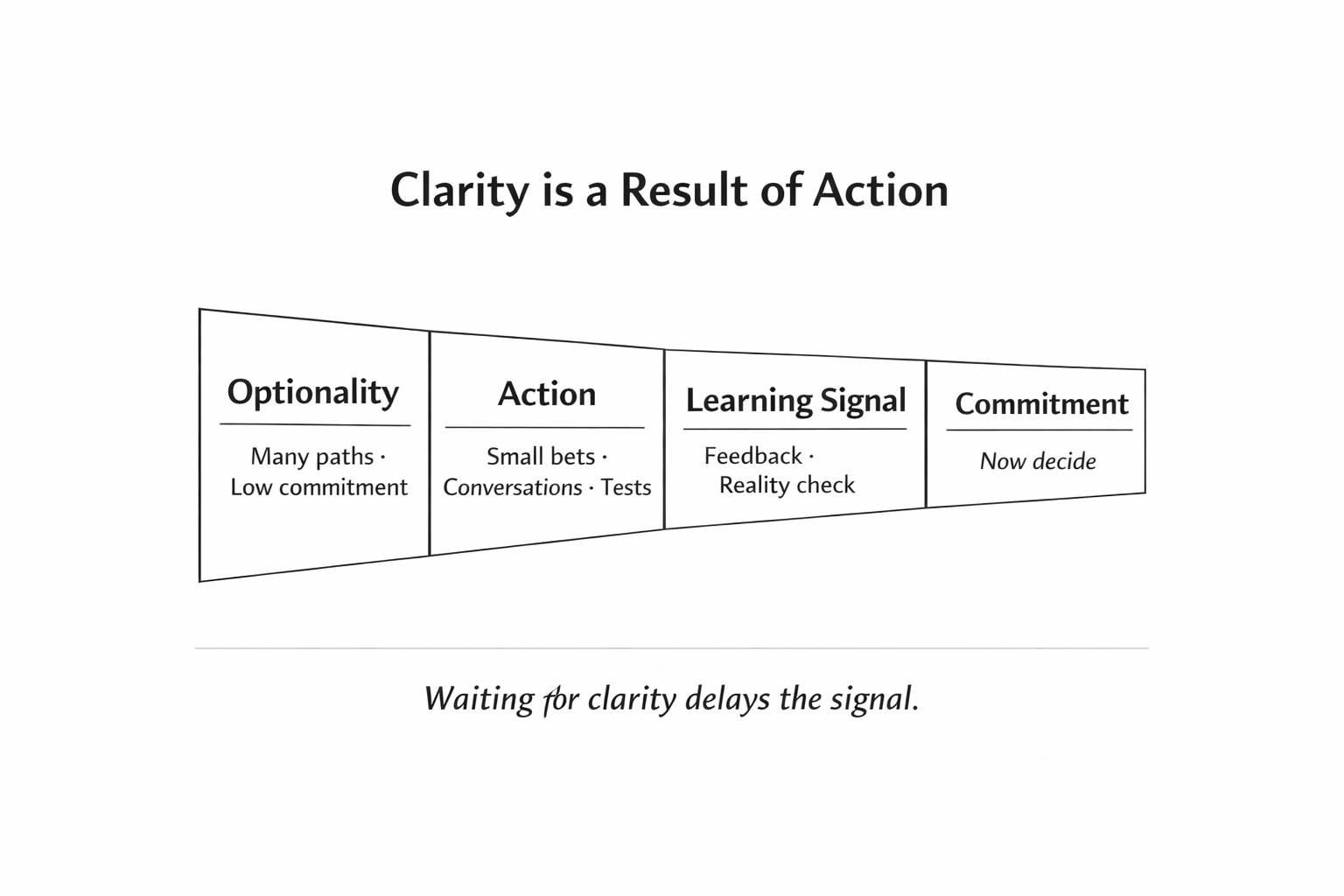
Clarity Comes From Moving — Not Waiting (and why optionality matters)
Most decisions that matter are made without perfect information.
In most situations (think regulated environments), that uncertainty can feel uncomfortable. The instinct is often to wait; for more data, clearer regulation, firmer demand signals, or alignment across stakeholders. Waiting feels prudent.
In practice, it often delays clarity.
I’ve learned that clarity rarely arrives before a decision. More often, it comes because a decision was made.
A real example
In one maritime new fuel project I worked on, the team spent a long time debating whether the project was “ready” to move forward.
The questions were reasonable:
Is demand strong enough?
Are regulations clear enough?
Is supply fully secured?
What if the market moves against us?
Each question led to more analysis. Each analysis uncovered new uncertainty. Progress slowed, even though there was broad agreement that the opportunity mattered.
What finally unlocked momentum wasn’t new information. It was reframing the decision.
Instead of asking “Are we certain this will work?”, the question became:
What decision do we need to make now to learn more?
How do we move forward in a way that preserves optionality?
What would tell us to double down — or to pivot?
Once framed that way, the path forward was clearer.
Waiting for certainty
Is demand guaranteed?
Are all rules final?
Can we eliminate risk?
What if we’re wrong?
Moving to gain clarity
What level of demand is enough to test the next step?
Which assumptions must hold now, and which can evolve?
How do we move while keeping optionality?
What would trigger a pivot?
Why optionality matters
Moving forward doesn’t mean committing blindly. In fact, the best decisions I’ve seen are designed to:
unlock information quickly
limit irreversible commitments
make it easier to change course if reality disagrees
Optionality turns uncertainty from a reason to wait into a reason to move — carefully.
In the maritime new fuel example, the decision wasn’t “go all in.” It was “take the next step that gives us signal.” That step created clarity the analysis couldn’t.
A simple decision test I use
When a team is stuck waiting for certainty, I ask three questions:
What is the smallest decision (no regret) we can make that gives us real information?
What does this decision commit us to, and what does it deliberately leave open?
What would tell us to continue, pause, or pivot?
If we can answer those three clearly, moving forward is usually safer than waiting.
The takeaway
In complex environments, certainty is rarely available when it’s needed. Clarity is, and it is often a result of action — not a prerequisite for it. The key is to move in ways that either increase clarity or preserve optionality.