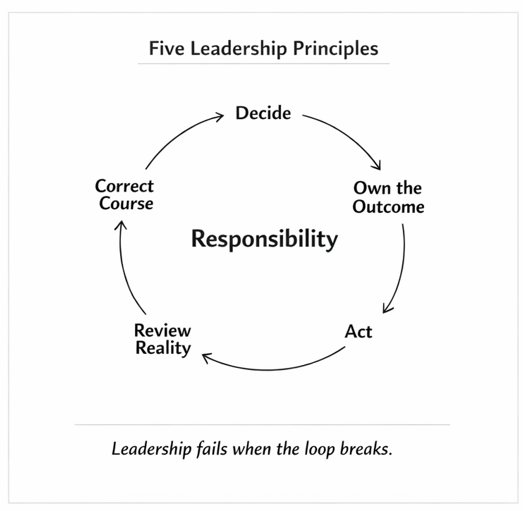
Five Leadership Principles (hint: it is all about Responsibility…)
I’ve spent most of my career in large, complex organisations that is global, technically strong, and process-heavy.
I’ve worked with capable leaders who care deeply about doing the right thing. Yet I’ve also seen how easily leadership gets diluted when decisions require universal alignment before they can move forward.
Over time, a pattern became impossible to ignore:
the biggest leadership failures weren’t about bad intent or poor analysis; they were about avoided responsibility.
The leadership principles I wrote below didn’t come from a single role, book or moment. They were shaped by experience, reinforced by mistakes, and sharpened by reading thinkers who take leadership seriously.
Principle 1: Leadership Begins Where Alignment Ends
Alignment is valuable, well up to a point.
When decisions wait for every stakeholder to agree, responsibility has already been diffused. Consensus may be achieved, but leadership has quietly exited the room.
Leadership starts precisely when alignment breaks down. When trade-offs are real and someone must decide anyway.
This echoes what Ronald Heifetz describes as adaptive leadership: moments where authority cannot rely on technical answers and must instead exercise judgement.
Principle 2: Responsibility Is the Job, Not the Outcome
Leaders are not paid for certainty. They are paid to own decisions under uncertainty.
If a decision succeeds, credit will be shared. If it fails, responsibility should not be.
Peter Drucker was explicit about this: the essence of management, and leadership, is accountability for decisions and results, not popularity or intent.
If no one is willing to own the downside, then no one is truly leading.
Principle 3: Input Is Collective. Ownership Is Singular.
Strong leaders seek diverse input. Effective leaders make ownership unmistakably clear.
This principle shows up repeatedly in high-performing organisations and is consistent with what Andy Grove emphasised at Intel: decision rights must be clear, or execution collapses.
Principle 4: Process Does Not Replace Judgement
Process exists to support leadership, not substitute for it.
When leaders hide behind governance, reviews, or procedural sequencing, they send a clear signal: No one here is willing to stand behind a decision.
Judgement is what leaders are paid for. Process merely records it. This distinction is at the heart of Doris Kearns Goodwin’s work on leadership under pressure: great leaders use systems, but they do not abdicate judgement to them.
Principle 5: The Only Question That Matters
Before any major decision, I now ask one question:
“If this goes wrong, who owns it?”
If the answer is unclear, leadership is missing , regardless of titles in the room.
The Standard
Leadership is not about consensus. It is not about comfort. It is not about being liked.
Leadership is about responsibility; taken early, owned clearly, and carried personally.
That is what leaders are paid to do.
My intellectual influences (not exhaustive)
Peter Drucker — The Effective Executive
Ronald Heifetz — Leadership Without Easy Answers
Andy Grove — High Output Management
Doris Kearns Goodwin — Leadership in Turbulent Times
Jim Collins — Level 5 Leadership (discipline over ego, responsibility over credit)
